
Physical AI and AIoT for Display Manufacturing
Connect display production data with the physical processes behind every panel. Display manufacturing depends on controlled production environments, precise material handling, consistent equipment operation, and reliable quality inspection.
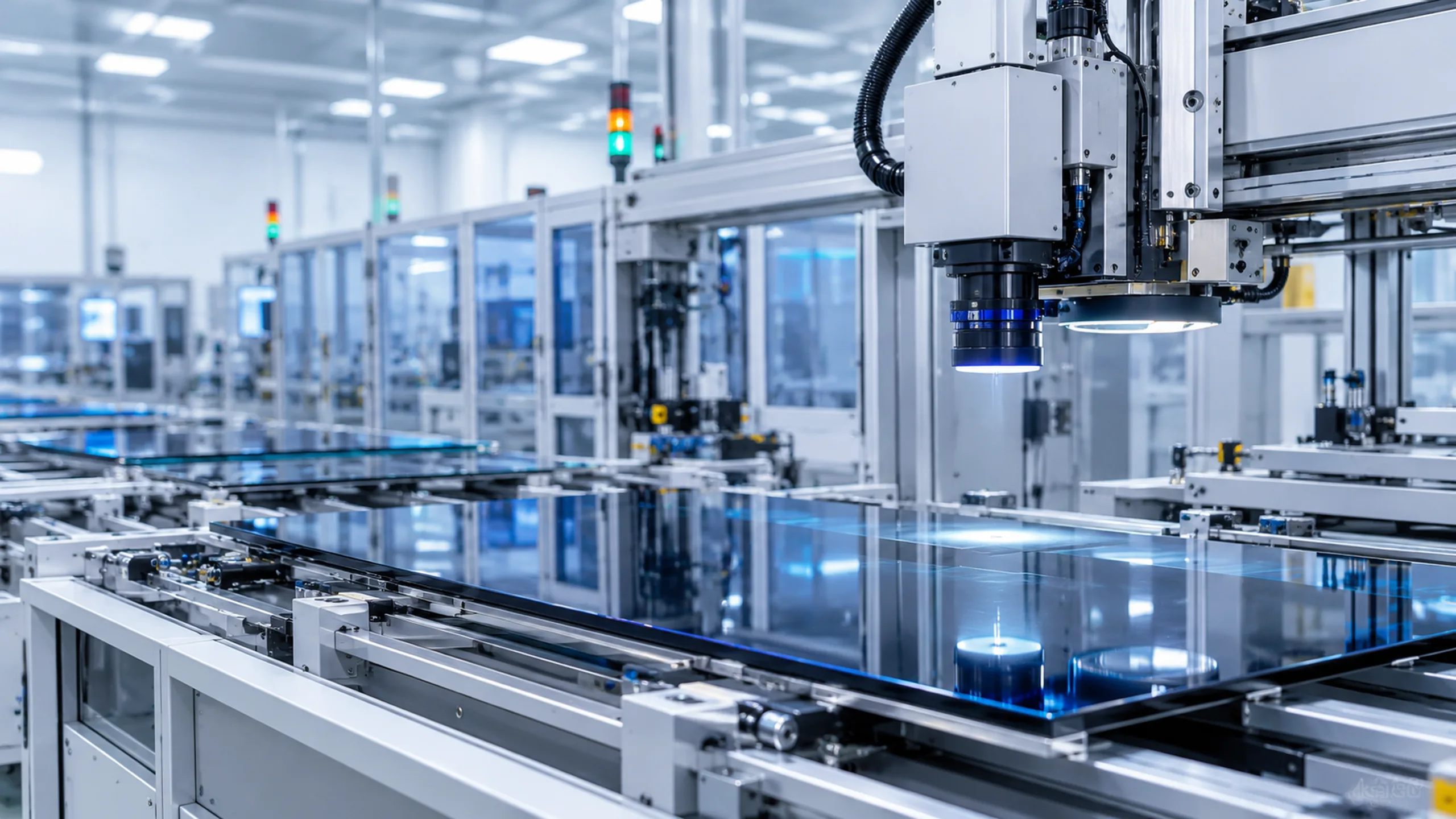
DisplayCore focuses on Physical AI and Artificial Intelligence of Things (AIoT) approaches that connect identification, sensing, AI-supported decisions, and, where appropriately engineered and authorized, physical action.
The goal is to help teams build a clearer view of what is moving through production, how equipment and process conditions are changing, and which events require review. Each application must be designed around the facility’s actual equipment, data, operating limits, and integration requirements.
Why Physical AI and AIoT matter in display production
Display production teams work across connected stages, equipment groups, and quality checkpoints. Information can become fragmented when material identity, machine condition, inspection findings, and production records are stored in separate systems. Physical AI and AIoT provide a way to connect these observations with operational decisions while keeping data quality, human authority, and equipment safeguards in view.
Three operational priorities
1. Panel and material traceability
Display glass, work in progress, panels, and finished modules move between process and inspection areas. Missed scans, duplicate events, delayed updates, or incorrect associations can leave production teams uncertain about an item’s latest location or status. An identification workflow can combine suitable radio-frequency identification (RFID), Bluetooth Low Energy (BLE), ultra-wideband (UWB), or vision observations with timestamps and production records. The appropriate method depends on material characteristics, line layout, read coverage, and the required level of location detail.
2. Equipment and process condition visibility
Production equipment requires consistent operation and timely maintenance attention. Depending on the asset and process, relevant inputs may include temperature, vibration, pressure, electrical measurements, machine state, and environmental readings. Connecting measurements with asset identity, operating mode, time, and sensor-health information helps engineers distinguish meaningful changes from missing, stale, or unreliable data.
3. Inspection and quality review
Display quality workflows may include visual review of panel surfaces, component presence, alignment, or other defined acceptance criteria. Machine-vision or other sensor data can support AI-assisted assessment when representative images, defect labels, lighting conditions, and inspection standards are available. Uncertain findings should be routed for human review, and performance must be evaluated for both missed defects and false rejects before operational use.
Solution pathways for display manufacturing
DisplayCore organizes potential applications around the production questions they help teams investigate. The scope and implementation status of each workflow should be confirmed during requirements assessment.
Explore DisplayCore solutions ↗
Asset and material tracking
Connect panel, material, and work-in-progress identity with movement events and handoff records. Pilot measures can include event completeness, incorrect associations, unresolved transfers, and reconciliation time. Learn more about asset and material tracking ↗
Condition monitoring
Associate equipment measurements with asset identity, operating mode, and sensor health. Evaluate alert usefulness, detection delay, missing-data handling, and maintenance follow-up. Learn more about condition monitoring ↗
Inspection and quality intelligence
Structure image or sensor capture, AI-supported assessment, exception routing, and human review around defined defect classes and acceptance criteria. This is an application pathway to validate, not a claim of deployed inspection performance. Learn more about inspection and quality intelligence ↗
Predictive maintenance
Where sufficient failure history and maintenance labels exist, assess whether condition data can support maintenance prioritization. Anomaly detection, failure-risk estimation, and remaining-life prediction are different capabilities and should not be treated as interchangeable. Learn more about predictive maintenance ↗
Operational optimization and physical action
Evaluate constrained recommendations or approved equipment actions only when interfaces, permissions, operating limits, fallback behavior, and independent outcome checks are defined. Learn more about operational optimization and physical action ↗
A connected architecture: identify, sense, decide, act
DisplayCore’s engine approach connects physical observations with operational decisions. The three-engine AIoT configuration brings together identification, sensing, and AI-supported decision functions. The four-engine Physical AI configuration adds a physical action function where a suitable, authorized control path exists.
- Identify: Associate a panel, material lot, production asset, or equipment item with a reliable identifier and relevant movement or event record.
- Sense: Capture physical measurements or inspection data, then retain units, timestamps, operating context, and quality indicators.
- Decide: Apply rules or evaluated AI methods to detect exceptions, prioritize review, or recommend a next step. Outputs should include enough context for the responsible user to assess uncertainty.
- Act: Where the use case and engineering controls permit, connect an approved decision to a bounded equipment interface. Confirm the resulting physical state independently; a command acknowledgment alone does not prove that an action was completed.
Designed around your production environment
A useful deployment begins with the operational boundary, not a predetermined device or installation model. The design should identify the equipment and material classes in scope, observation points, data owners, users, system interfaces, and decisions that the workflow is intended to support.
Depending on the facility, relevant integration points may include Manufacturing Execution Systems (MES), Enterprise Resource Planning (ERP), Computerized Maintenance Management Systems (CMMS), Supervisory Control and Data Acquisition (SCADA), equipment controllers, inspection stations, and existing data services. These are potential integration targets, not a statement that prebuilt connectors are currently available.
Deployment may involve edge processing, customer-managed servers, private hosting, or cloud services. The right arrangement depends on latency, network reliability, data governance, cybersecurity, maintenance responsibility, and the facility’s operating policies. Specific protocols, devices, and interfaces must be checked against the selected equipment and tested before compatibility is claimed.
Evaluate with evidence before expanding
A pilot should answer a defined production question under representative conditions. Establish a baseline, select measurable acceptance criteria, and include routine operation as well as exceptions such as missed observations, duplicate events, sensor drift, delayed messages, network interruption, and operator intervention.
Useful measures may include traceability event completeness, false association rate, inspection recall and false rejects by defect class, alert rate per operating hour, detection delay, reconciliation time, maintenance effort, and independently verified action outcomes. Metrics should be defined with units, denominators, time windows, and exclusions. Results from synthetic data or simulation must be labeled as such and must not be presented as customer deployment results.
DisplayCore’s approach is to make assumptions, dependencies, and evidence gaps visible so that engineering, operations, quality, maintenance, and IT teams can decide whether a workflow is ready for a controlled pilot.
Discuss your display manufacturing application
Start with the process or equipment question that matters most to your facility. Share the production area, asset or material class, available observations, existing systems, and the decision your team needs to improve. DisplayCore can use that context to frame an application discussion, identify integration dependencies, and define what a meaningful evaluation would need to prove.